HashNet Knowledge
Jens Laustsen’s HashNet webinar: mining, payouts and referrals
A recap of the 17 November webinar: Jens Laustsen, HashNet’s Chief Network Officer, explains mining leases, the Alpha Engine, BTC/USDT payouts and referral bonuses.
Jens Laustsen speaking during the 17 November webinar.
Jens Laustsen, HashNet’s Chief Network Officer (CNO), led the English webinar on 17 November 2026. He explained the mining hardware lease, the Alpha Engine software, payouts in Bitcoin (BTC) and the stablecoin USDT, and the referral model. Two HashNet users also shared their experiences: Chris demonstrated his account dashboard, called Backoffice, while Richmond spoke from Vienna about his involvement and team.
On this page
References & video
Attachments
- HashNet: Mine What Matters, opens in a new tab
- Presentation assumptions and risk disclaimer, opens in a new tab
- Bitcoin and traditional assets: the presentation’s five-year comparison, opens in a new tab
- Bitcoin price scenario 2030, opens in a new tab
- Ian Issa: founder and CEO, opens in a new tab
- World’s smartest way to mine crypto, opens in a new tab
- Four benefits presented for mining with HashNet, opens in a new tab
- Four machines, six coins, opens in a new tab
- The Alpha Engine: coin and pool selection, opens in a new tab
- Mining pools shown in the presentation, opens in a new tab
- Blockchain payment tracking shown in the presentation, opens in a new tab
- Mining hardware lease starting at $250, opens in a new tab
- Lease term and historical average output as presented, opens in a new tab
- Payout strategy: 70% USDT and 30% BTC shown as default, opens in a new tab
- Invoice and machine serial number, opens in a new tab
- Marketplace listing after 90 days: conditions shown, opens in a new tab
- Payment methods shown for getting started, opens in a new tab
- Worldwide community as presented, opens in a new tab
- How HashNet groups the Alpha Engine, hardware and blockchain, opens in a new tab
- Referral bonus overview and displayed 3× income limit, opens in a new tab
- Eight-hour cashflow and contact slide, opens in a new tab
- Chris speaking during the webinar, opens in a new tab
- Jens Laustsen during the webinar, opens in a new tab
- Richmond speaking from Vienna, opens in a new tab
The key points
- The lease starts at $250 for 18 months, shown on the slide as 540 days.
- The Alpha Engine was described as coordinating compatible machines and pools across six cryptocurrencies, with output converted into BTC or USDT.
- Jens outlined 24 hours of setup, then the first payout eight hours later—about 32 hours in total. Further payments follow an eight-hour cycle, with variable output.
- The Backoffice slider lets customers choose their payout mix. The slide showed 70% USDT and 30% BTC as the default.
- Referral bonuses and a proposed resale marketplace were presented with separate conditions and limits.
How the hardware and Alpha Engine were explained
Jens described the retail offering as still in soft launch, while saying its underlying technology had operated for over four years for high-net-worth clients. He introduced founder and CEO Ian Issa through his experience dating to 2017 and background as an elite athlete.
His Formula One analogy separated the equipment from its operation: the hardware is the car, while the Alpha Engine is intended to optimise how it is driven.
The four-machine overview covered Bitcoin, Bitcoin Cash, Litecoin, Dogecoin, Zcash and Kaspa. Jens said two machines mine one specific coin each; the other two can switch between compatible coins. Each machine mines one coin at a time.
He described proprietary software developed by Ian and his team, considering mining output, pool costs and blockchain activity before routing compatible mining power. The stated switching time was 12 milliseconds. An illustration compared Bitcoin paying $7 with Bitcoin Cash paying $9 to explain the switching rationale.
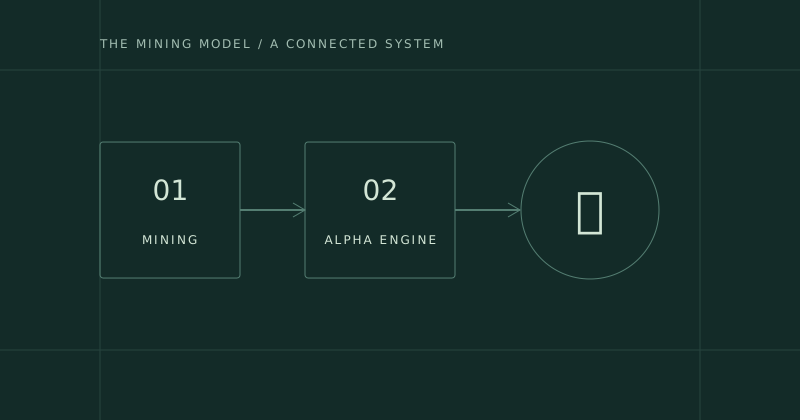
The pool slide displayed Antpool, Spiderpool, f2pool, ViaBTC, Luxor, Litecoinpool.org and 2Miners. A diagram grouped the Alpha Engine, hardware and blockchain records as “brain,” “muscle” and “proof.”
The Alpha Engine, hardware and blockchain grouped as brain, muscle and proof in the presentation.
Getting started, payout timing and currency choice
Jens presented the lease as an alternative to arranging mining equipment, electricity, a location and maintenance yourself. He said people without cryptocurrency could pay by Visa, Mastercard or Apple Pay; the checkout slide also showed crypto payments.
He described a 24-hour setup and a first payout eight hours later, with a custodian handling subsequent eight-hour payments. He stressed that output varies from day to day.
The six mining currencies are distinct from the payout choices. Output was described as automatically converted into BTC or USDT, with a Backoffice slider controlling the allocation. The default shown was 70% USDT and 30% BTC.
Jens framed the choice as cashflow versus Bitcoin accumulation. For a fixed dollar amount, a lower Bitcoin price buys more BTC. He linked this conversion example to a possible future recovery in Bitcoin’s price.
The presentation shows a 70% USDT / 30% BTC default. Its amounts are an illustration.
Following activity in the Backoffice
Jens said customers could see which coins were being mined and review payout history. The presentation showed blockchain-explorer views and wallet-address cards for inspecting transfers.
He reported over 1,642 machines across five locations and, separately, more than 20,000 people using the product worldwide. He called the community slide’s 20,000 figure an older number. People and equipment were different measures.
The Backoffice showed the account activity being discussed; blockchain records concerned transfers. Transfer records alone do not provide a full account of mining costs or profitability.
Lease documentation and the proposed resale market
Jens said customers receive an invoice and unique serial number. Explaining “True ownership,” he referred to the leasing contract belonging to its holder and compared it with leasing a car.
He described a planned marketplace for reselling a contract worth more than $1,000 after 90 days, linked to a Dubai launch event at the beginning of February. No exact event date was given.
Listing and completing a sale are different steps. Jens expected buyers for paying contracts; he did not describe a platform buyback or immediate refund. The 90-day and over-$1,000 conditions accompanied the slide headed “Exit anytime.”
The referral bonuses and the 3x income limit
Jens introduced referral income alongside the holder’s own mining output:
- Direct Bonus: 2% direct sales bonus.
- Yield Share: 40%, related to output and the referral organisation.
- Infinity Bonus: up to 6%.
- Leadership Match: up to 15%.
He explained Yield Share as an amount equivalent to 40% of the contract holder’s output, shared with the referral organisation in addition to the holder’s payout, not deducted from it.
He also introduced an income limit of three times the lease value. The “3X Income Limit” slide and discussion did not specify precisely which income categories count towards it or all bonus qualification rules.
His message was that customers could show others their Backoffice and experience, with referrals as a possible additional income stream.
The four referral-bonus categories and the 3× income-limit label shown during the session.
The figures and assumptions used in the presentation
The lease slide displayed “10.5% Average Output,” based on the previous four years. Jens described historical averages and results moving above and below them. Neither the slide nor his explanation specified a measurement period for that percentage.
His Bitcoin introduction included a five-year asset comparison and 2030 price scenarios: $350,000 labelled “conservative,” $450,000 “base” and $700,000 “optimistic,” alongside higher forecasts attributed to industry figures. These future scenarios were separate from historical mining output.
At the start, Jens said figures were estimates rather than guarantees and read a disclaimer describing significant risk and possible loss. Later, he described the single-user opportunity as “without any risk.”
Two HashNet users share their experience
Chris said he joined without prior crypto knowledge and had initially been unsure what to do or whom to trust. His Backoffice walkthrough focused on seeing activity and payments, showing the account to others and choosing Bitcoin or stablecoin output.
He reported Bitcoin payments every eight hours and 20 signups that day.
Richmond, speaking from Vienna, Austria, described six months of involvement and a team of more than 3,000 people. He highlighted his inviter, the community and the leadership’s willingness to show and explain the business.
What happens next
Jens closed by asking attendees to contact the person who invited them, ask any remaining questions and look at a Backoffice themselves.
He announced another presentation for Thursday at the same time: 19 November, at 17:00 CET / 20:00 Dubai time, using the schedule shown for this meeting.
The gallery contains 21 presentation slides and three speaker images. Original slides remain in English and can be opened at full size.
Explore the presentation and speaker images
Browse the presentation
Swipe or use the arrows. Open a slide to read it at full size.
The opening slide from Jens’s 17 November presentation.
Original slide files
- HashNet: Mine What Matters ↗, opens in a new tab
- Presentation assumptions and risk disclaimer ↗, opens in a new tab
- Bitcoin and traditional assets: the presentation’s five-year comparison ↗, opens in a new tab
- Bitcoin price scenario 2030 ↗, opens in a new tab
- Ian Issa: founder and CEO ↗, opens in a new tab
- World’s smartest way to mine crypto ↗, opens in a new tab
- Four benefits presented for mining with HashNet ↗, opens in a new tab
- Four machines, six coins ↗, opens in a new tab
- The Alpha Engine: coin and pool selection ↗, opens in a new tab
- Mining pools shown in the presentation ↗, opens in a new tab
- Blockchain payment tracking shown in the presentation ↗, opens in a new tab
- Mining hardware lease starting at $250 ↗, opens in a new tab
- Lease term and historical average output as presented ↗, opens in a new tab
- Payout strategy: 70% USDT and 30% BTC shown as default ↗, opens in a new tab
- Invoice and machine serial number ↗, opens in a new tab
- Marketplace listing after 90 days: conditions shown ↗, opens in a new tab
- Payment methods shown for getting started ↗, opens in a new tab
- Worldwide community as presented ↗, opens in a new tab
- How HashNet groups the Alpha Engine, hardware and blockchain ↗, opens in a new tab
- Referral bonus overview and displayed 3× income limit ↗, opens in a new tab
- Eight-hour cashflow and contact slide ↗, opens in a new tab
- Chris speaking during the webinar ↗, opens in a new tab
- Jens Laustsen during the webinar ↗, opens in a new tab
- Richmond speaking from Vienna ↗, opens in a new tab
Source: supplied transcript and captures from HashNet’s English presentation on 17 November 2026, with Jens Laustsen, Chris and Richmond.